
COPAT Trial: Transitioning to Oral Antibiotics Safely
October 14, 2026 2026-10-13 13:56COPAT Trial: Transitioning to Oral Antibiotics Safely
 Abrampah PharmD, BCGP, BCMTMS, SIDP-CASP, APh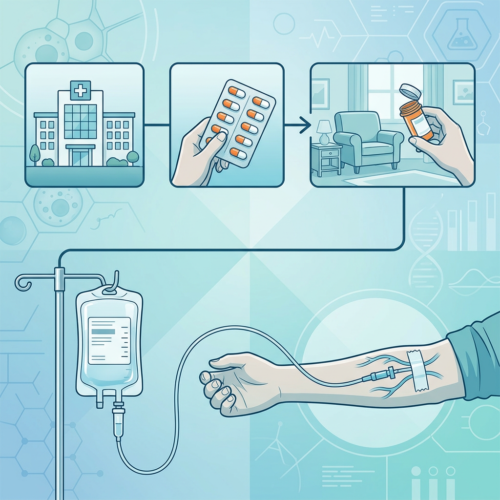
COPAT Trial: Transitioning to Oral Antibiotics Safely
COPAT Trial — Executive Summary
In hospitalized adults who are otherwise ready for discharge but still require ≥2 additional weeks of antimicrobial therapy, can early transition to oral antibiotics provide equivalent efficacy with better safety than continuing IV antibiotics through an OPAT program?
Study design
- Pragmatic, open-label randomized controlled trial
- Conducted at 5 hospitals within the West Virginia University health system
- Adults with serious infections requiring ≥2 additional weeks of IV antibiotics
- Randomized 2:1:
- Early-oral/COpAT: transition to an appropriate oral antibiotic at discharge
- IV/OPAT: continued IV antibiotics
- Follow-up at 2, 6, and 12 weeks
- Enrollment: August 2023–February 2025
- The trial was stopped early at approximately two-thirds enrollment because of a significant safety advantage in the oral group.
What infections were included? This is an important distinction from OVIVA.
OVIVA established that oral therapy was noninferior to IV therapy for bone and joint infections. In 1,054 patients, treatment failure was 14.6% with IV versus 13.2% with oral therapy. IV therapy also produced substantially more catheter complications.
COPAT goes further by asking whether this principle can be applied across a much broader spectrum of serious infections in a real-world COpAT/OPAT program.
COPAT included a broad range of infections, including:
- Bone/joint infections
- Endovascular infections, including endocarditis
- Skin/soft-tissue infections
- Pulmonary infections
- GI infections
- GU infections
- Other deep-seated infections
CNS infections were excluded. Patients also needed to have an appropriate oral option and be suitable for structured outpatient monitoring.
Main results
| Outcome | Early oral/COpAT | IV/OPAT |
| Antibiotic-related adverse events | 3.2% | 6.5% |
| Hazard of first study-related adverse event | HR 0.24 | Reference |
| Efficacy | Equivalent | Reference |
| Clinical cure/control | Essentially equivalent | Essentially equivalent |
The difference in adverse events was statistically significant (3.2% vs 6.5%, P=.02). The reduction in adverse event risk became apparent as early as approximately day 10.
Importantly, therapeutic efficacy was equivalent between groups. Subsequent detailed reporting found that essentially all patients achieved clinical cure/control, with only one patient requiring additional surgery for source control.
Why was oral therapy safer?
The fundamental advantage is that COpAT avoids many complications associated with prolonged IV therapy:
- PICC/central-line complications
- Line infections
- Thrombosis
- Mechanical problems
- IV administration complications
- Some medication-related toxicities associated with prolonged parenteral therapy
Important caveat
COPAT does not mean every serious infection should be switched to PO. Appropriate patient selection remains critical. The trial required:
- A suitable oral antimicrobial option
- Adequate susceptibility data
- Ability to absorb oral medication
- Clinical stability
- Appropriate outpatient environment
- Structured follow-up and laboratory monitoring
- And some infections/patients still warrant IV therapy.
Bottom Line
The COPAT trial demonstrated that, among appropriately selected patients with serious infections requiring prolonged antimicrobial therapy, early transition from IV to effective oral antibiotics was associated with significantly fewer adverse events while maintaining equivalent clinical efficacy.
The trial’s message isn’t simply “PO antibiotics are as good as IV.” It’s more powerful:
When an effective oral option exists, continuing IV therapy may expose patients to unnecessary harm without improving efficacy.
Why COPAT is especially important for antimicrobial stewardship.
Traditional model:
“Patient needs 6 weeks of antibiotics → discharge with PICC → OPAT.”
COPAT model:
“Patient needs 6 weeks of antibiotics → determine whether the remaining therapy actually requires IV administration; if an effective oral agent exists, transition to COpAT with structured monitoring.”
This represents a change in the default mindset from “How do we safely continue IV therapy?” to “Does this patient still need IV therapy?”
The trial also demonstrated that implementation itself can change prescribing behavior. Greater enrollment in COPAT was associated with a higher COpAT-to-OPAT consultation ratio, suggesting that exposure to the trial helped clinicians become more comfortable with early oral therapy.
